
There’s something about the sea that stirs the souls of lonely people. It’s vast, boundless and unpredictable, and when she turns, you’re at her mercy.
If, like myself, you come from seafaring stock, you may be familiar with tall tales of voyages past, so grab yourself a bottle of rum and settle in to explore three maritime mysteries that’ll shiver your timbers.
The Mary Celeste
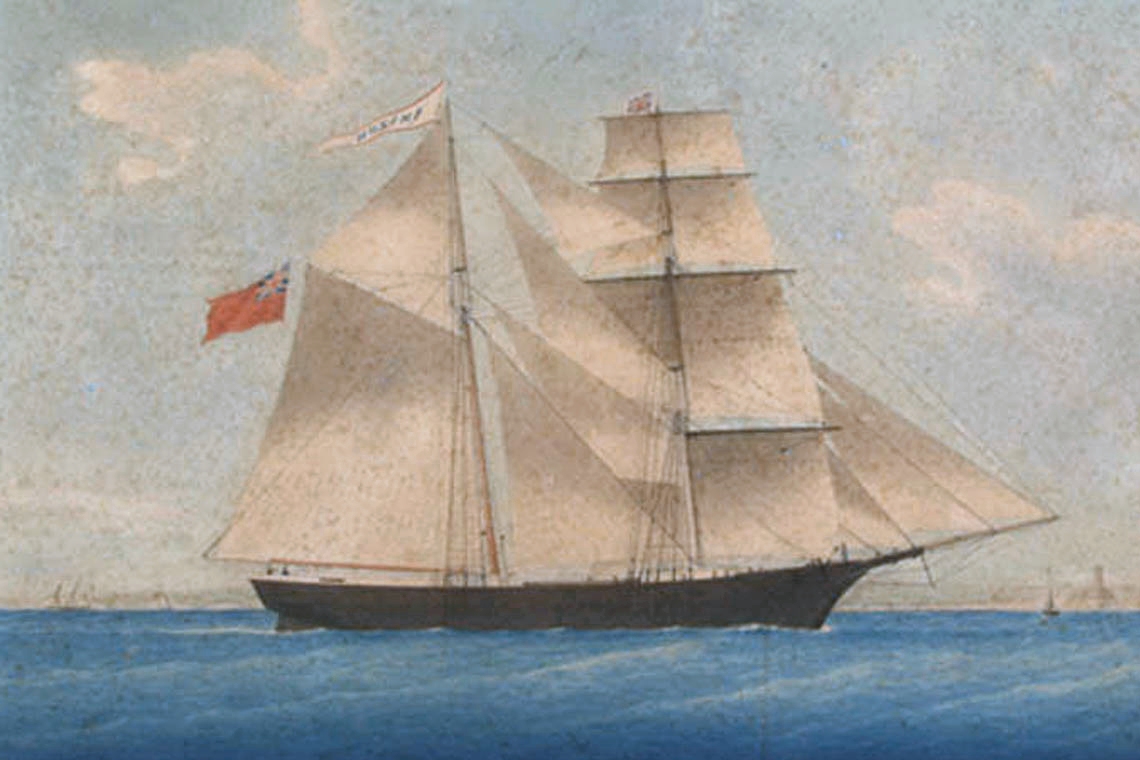
On December 5th, 1872, a merchant brigantine was found adrift off the Azores Islands by the Canadian ship Dei Gratia.
When sailors form the Dei Gratia boarded the ship, they found it eerily quiet. The crew’s personal belongings, food and cargo undisturbed, except for one, crucial exception. The entire crew and a life boat was missing.
They were never heard from again.
Although its sails were in poor condition, The Mary Celeste was found to be in a seaworthy. Three and a half feet of water had flooded the hold, but for the size of the ship, this shouldn’t have been a concern, although a single pump was found dismantled and a few hatches were found removed. The ship’s cargo – numerous barrels of industrial alcohol – were also intact.
The ships daily log was found and it’s final enter was dated November 25th – nine days before the ghost ship was discovered, when it was nearly 400 nautical miles (or 740km) away from the location it was found.
There was no sign of a mutiny – the ships captain, Benjamin Briggs, having hand selected the small crew of seven described as “peacable and first-class sailors”. In addition to the crew, Captain Briggs’s wife and infant daughter accompanied them.
It’s here that fact and fiction begin to intertwine.
The fate of the Mary Celeste gave rise to dozens of theories across the decades and subsequent centuries since it’s abandonment, including but not limited to, pirates, natural disasters, sea monsters and “crazed ex-slaves with a lust for vengeance” – the latter being an invention of the author Arthur Conan Doyle.
It’s likely the abandonment was a combination of natural factors. One theory supposes the alcohol vapours in the cargo hold expanded in the heat and blew off the hatch, or caused the crew to open them, in fear of an explosion. This fear could have lead the captain to abandon ship, the lifeboat later being overcome by bad weather. However, the boarding party did not report the smell of alcohol fumes, and noted that the main hatch was sealed.
Still, of the 1701 barrels in the hold, nine of them were empty. This caused a few to speculate they’d been drunk dry by the crew, this is unlikely, as nine barrels worth of industrial alcohol would probably be undrinkable, even by a group of sailors. In fact, the empty barrels were the only ones made from red oak, a porous wood that was prone to leaking.
Although the tale of the ghost ship, Mary Celeste, terrified me in my youth, it’s likely the result of a worried captain making the fateful decision to abandon ship due to to a collection of facts that are currently unknown. The lifeboat being subsequently overcome in rough waters.
But until the sea gives up its ghosts, we’ll never know for sure.
The Flying Dutchman

From one ghost ship to another, more literal one.
The Flying Dutchman is a legendary ship, cursed to sail the seven seas and never make it to port. Siting this ghostly galleon is said to foretell doom.
The first written mention of the Dutchman is though to appear in John MacDonald’s Travels in various part of Europe, Asia and Africa during a series of thirty years and upwards, in 1790, which describes the sailors spotting the Dutchman in bad weather, going on to describe how it had been lost while attempting to make it to harbour around the Cape of Good Hope.
In a more romantic retelling of the legend, some claim that the ship’s Captain, finding himself trapped in the stormy weather swore he’d make port, even if he had to sail until judgement day. Other retellings claim it was an act of hubris, the result of gambling with the devil himself, or a nautical variation of the Wild Hunt.
Either way, the ship and its crew were doomed.
Whatever story you choose to believe, it’s likely that sailors have actually sighted the ghostly image of the The Flying Dutchman across the horizon, or sailing above storm clouds, though it might, unfortunately, not be supernatural in origin. It’s more likely the result of mirage, or another type of optical illusion, best described by an extract from Frank Richard Stockton’s Round-about Rambles in Lands of Fact and Fancy as follows:
The news soon spread through the vessel that a phantom-ship with a ghostly crew was sailing in the air over a phantom-ocean, and that it was a bad omen, and meant that not one of them should ever see land again. The captain was told the wonderful tale, and coming on deck, he explained to the sailors that this strange appearance was caused by the reflection of some ship that was sailing on the water below this image, but at such a distance they could not see it. There were certain conditions of the atmosphere, he said, when the sun’s rays could form a perfect picture in the air of objects on the earth, like the images one sees in glass or water, but they were not generally upright, as in the case of this ship, but reversed—turned bottom upwards. This appearance in the air is called a mirage. He told a sailor to go up to the foretop and look beyond the phantom-ship. The man obeyed, and reported that he could see on the water, below the ship in the air, one precisely like it. Just then another ship was seen in the air, only this one was a steamship, and was bottom-upwards, as the captain had said these mirages generally appeared. Soon after, the steamship itself came in sight. The sailors were now convinced, and never afterwards believed in phantom-ships.
So if you ever find yourself sailing around the Cape of Good Hope, only to look to the sky and spot the Dutchman, make sure you pay close attention to it. It might be an illusion, but if you look closely and see the vessel manned by a skeletal crew, you may be in for a spell of bad weather.
The Bermuda Triangle

Much like quicksand, I really thought the Bermuda Triangle would cause me more of an issue as a grown up.
The Bermuda Triangle, sometimes known as the Devil’s Triangle, is a 5000,000 square mile area of ocean between Florida, Bermuda and Puerto Rico which, legends claim, is responsible for the unusual disappearances of multiple aircrafts and ships.
A 1950s article published in The Miami Herald is thought to have been the earliest modern record suggesting something odd about the area, although one of its most infamous tragedies took place years earlier in 1918 with the sinking of the USS Cyclops.
This 542-foot Navy cargo ship sank with over 10,000 tons of manganese ore, resulting in the loss of over 300 men. The ship went down without a distress call and despite multiple searches, no wreckage has been found. In 1941, the Cyclops’s sister ships, the USS Proteus and USS Nereus both sank in the same area.
It’s not only ships that are said to fall victim to the triangle. One of the most infamous and large scale disappearances took place in December 1945, with the loss of Flight 19, when a group of five separate TBM Avenger torpedo bombers disappeared during a navigation training flight.
During the subsequent search, one of the two Martin PBM-5 Mariner flying boats also disappeared in a presumed mid-air explosion. Between this and the members of Flight 19, the 27 crew members were never seen again.
Even today, the area known as the Bermuda Triangle continues to strike fear in the hearts of travellers, however, there is of course, skepticism over the nature of the area.
Many claim the number of incidents in the triangle is, one average, no more deadly than any other area of ocean. In fact when the WWF Charity identified the world’s 10 most dangerous shipping waters, the Bermuda Triangle was not among them.
But what do you think? Are there mysterious forces at play in the Bermuda Triangle? Or is it a manufactured mystery, perpetuated by paranormal reality programs and entertainment media? The area is known for frequent tropical cyclones that may account for some of the cases there, but I, for one, would rather not take my chances.
Follow The Hawthorn Files on social media for more and keep up to date with all manner of strangeness!


 The Hawthorn Files
One Comment Add yours