
Across the continents, there have always been stories of lake monsters. But are these frightening fishies just bedtime stories to keep the kids away from the water? Or are there really creatures that dwell within the worlds darkest lakes that are best described as monstrous. Let’s explore.
Champ – The Lake Champlain Monster
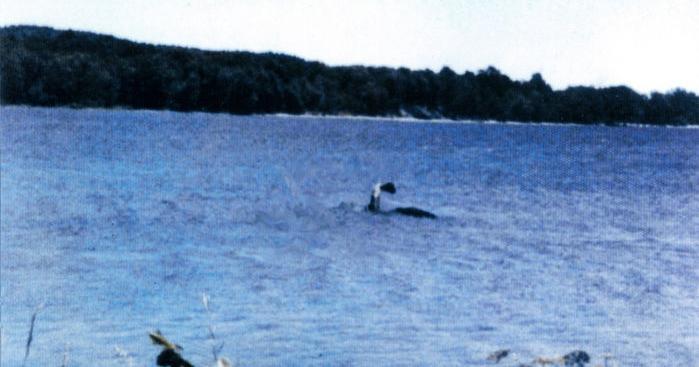
Lake Champlain is a freshwater lake that stretches all the way from New York state to Quebec, and according to believers, there’s one particular beast that calls it home, and his name is Champ.
Of course, Champ hasn’t always been its name. The Iroquois and Mohawk people are well acquainted with this apparent sea serpent, and know him as Onyare’kowa.
The first European settler to have seen Champ is supposedly the lake’s modern namesake, Samuel de Champlain – although this is disputed. Although this “sighting” was said to take place back in 1609, the first documented reference is from the 1970 issue of Vermont Life, which quotes Champlain saw a “20 ft (6.1 m) serpent thick as a barrel, and a head like a horse.”
Interest in the monster was renewed in 1977, when vacationer, Sandra Mansi, took the now infamous image of Champ you see above.
Although object captured is subject to debate – the depth of this part of the lake is only 14ft (4.3 metres) and far too shallow for a dinosaur-like creature to hide in – the plesiosaur-like image is what most monster hunters have come to expect. Although, if the creature is the sea-snake like the Iroquois believe, I reckon 14ft would be deep enough.
Of course, skeptics have suggested that the photo is nothing but a floating tree trunk, Champ has become a mascot in New York and Vermont and can be seen promoting anything from Baseball teams to car washes.
Ogopogo – The Okanagan Lake Monster

Hopping the boarder into Canada, Champ’s cousin, the delightfully named Ogopogo is said to inhabit British Columbia’s Okanagan Lake.
The area’s First Nation’s population of the area have always spoken about a being called Naitaka – “water demon” or “water spirit” – who demand a sacrifice to assure safe passage across the lake. One chief, Timbasket, refused a sacrifice before crossing, and the demon used its long tail to whip up the surface of the water, which pulled Timbasket’s canoe – and his family – to the bottom of the lake.
Ogopogo has been sighted periodically over the last hundred years, lead to cash rewards for proven sightings and has since been listed by Greenepace as an endangered species.
Still, skeptics suggest that the traditional sightings of a humpbacked creature are nothing more than misidentified otters which often swim in rows with an undulating type movement across the surface of the water. Waterspouts, which occur often on the lake, have also been given as a source of inspiration for tales of the creature.
I for one will not be crossing the lake without giving thanks to the water spirit.
Nessie – The Loch Ness Monster

No list of watery cryptids would be complete without this old girl. Good old Nessie is said to be a plesiosaur-like creature who lurks at the bottom of Loch Ness, inn the Scottish Highlands. Like her North American cousins, she is often sighted in the form of undulating humps across the water’s surface, and was first sighted in the 6th century AD, by Saint Columba.
The story goes that the Irish saint was visiting the Picts when they came across a man being buried by the River Ness. Locals said the Mann had been swimming in the Loch and had been pulled below by a monster. Saint Columba then sent one of his followers to swim across the river, and when the monster approached, it was driven away by the sign of the cross.
Nessie has been sighted across the centuries, with the most infamous sighting resulting in the so-called “Surgeon’s Photograph” in 1934. Published in the Daily Mail, the image is still synonymous with Nessie, despite being a well known hoax in the form of a toy submarine with a fake dinosaur-like attachment.
Despite this, belief in the creature has endured, despite more recent scientific studies suggesting that Nessie may be no more than a large eel, which are abundant in the loch. This was backed up by a 2018 DNA study went on to provide no evidence of any anomalous creature in the loch.
Personally, I subscribe to the theory that Nessie is the ghost of a plesiosaur, haunting the loch. She lives on inn my heart.
Don’t forget to subscribe and follow our social channels below!



 The Hawthorn Files